Friday Flash Fiction
  • Home
    • About Friday Flash Fiction
    • Writing Good Flash Fiction >
      • Competition Tips
    • Terms & Conditions
    • GDPR Compliance
  • 100-Word Stories
  • Other Archived Material
    • Longer Stories
    • Poetry
  • Authors
    • A
    • B
    • C
    • D
    • E-F
    • G-I
    • J-L
    • M-O
    • P-R
    • S-V
    • W-Z

Missing the Alarm, by Mary Wallace

21/2/2021

 
FOOD
The streets were empty; empty and silent. Clive was confused, unsure of what was happening. There were no half eaten burgers in the dumpster and he was hungry. He had been sleeping soundly for thirteen hours jammed in behind the cardboard boxes and his body was stiff. No one had moved him along.

That had never happened before. The police seemed to have added the small alley where he slept to their regular patrol, they evicted him at 2am every morning like clockwork.

Of course they knew that he would return straight away, but his disturbed sleep allowed them to tick a box on their duty sheet. Clive was philosophical about the disturbance, it wasn't as if he had work in the morning.

He glanced once more at the deserted streets, a shiver passing through him. He was used to being alone, but people were reassuring from a distance. One day he would have the courage to say "hello" and smile. Maybe. Perhaps now it was too late.

He wondered if they were all dead. He had seen them wearing masks and queueing for injections. He had been adamant that they weren't sticking stuff in his arm. That might be why he was the last man standing.

He was still hungry. He made his way down the street towards the corner, shocked when a firm hand emerged from the shadows and strong fingers gripped his arm.
"I came looking for you."
The gruff voice of his 2am alarm, calmed his nerves. "There's a gas leak, they've barricaded the entire block."

Guided by the policeman, Clive rounded the corner to a sea of faces.
"Hello," he greeted them, smiling shyly. His face lit up as he spotted the brimming yellow dumpster.
​

Orange Grove, by David McVey

21/2/2021

 
TRAVEL
Thin rays of dusty light angle across the cell. The air is thick and stale. He is aware of the stink of his own dirt and sweat and feels sometimes as if this bleak prison is all he can remember, so he strives to recall how he got here. It was when he went into the church and there was some kind of fight...

The hotel dining room was cramped but friendly. Each meal taught something about the geography of the island; fresh vegetables from farms on the green coast, spicy, colourful dishes from North Africa and plates piled with fresh local seafood. Eddie’s bedroom window looked out on the village square. A few other tourists sat outside the hotel drinking cocktails; at the cafe opposite, old men argued and laughed and played cards as the tinny bells of the church cleaved the soft sea breeze. An armed policeman swaggered into the square and past the cafe. The old men stopped talking and watched him go by.

On the third day of the holiday Eddie travelled from the village on the ancient service bus. The locals laughed wheezily at his fumbling schoolboy Spanish. He alighted deep in the countryside and followed sandy paths through orange groves and fields along the northern coastline.

He stopped; an orange grove dropped steeply to the silver-blue disc of the sea. Pines sheltered the crop from the hot, dry western winds. Eddie savoured the warm scents of sea-tang, citrus blossom and pine resin, then turned his back on the coast and picked his way towards the outskirts of the village. As he came through a belt of pines the air turned rank, smelling of human confinement and misery. Right on the edge of the village was a compound of shabby concrete buildings. Two leering, baton-wielding policemen smoked nearby.

When he reached the square Eddie entered the church and took a pew near the back to enjoy the coolness. Some old women prayed in the front pew. Then the door banged open and two more policemen walked in, their footfalls heavy and echoing. One old woman stood up and asked them to show respect. Eddie watched as the argument developed. One of the policemen wearily lifted his hand and struck the woman, who crumpled to the floor.

Eddie stormed towards the policemen and hit the woman’s attacker in the face. The other policeman restrained Eddie while his colleague recovered. Eddie saw a baton being brought down heavily and then knew only silence.

The sun declines and the cell grows dark.

He had been ordered to put pressure on the church, to enforce compliance with the new order but because he defended himself against this foreigner, he has been imprisoned. The Government needs money and is encouraging tourists. He wonders whether the Scotsman will live or die.

He lies down in the darkness. A light breeze has risen, carrying the scent of orange blossom into the cell.

Tea Sounds Nice, by Robert Walton

21/2/2021

 
FOOD
I love lavender - its sensuous scent, voluptuous despite such tiny blossoms, its violet color leaping into my eyes every morning. I look to my right. Poppies - their molten gold dueling with the sun - greet me. Sweet peas twinkle on trellises beyond. Daisies and marigolds dance near. Among all hum my bees.
As the morning warms, they warm to their work. I’ve taken honey from their hives already, six jars - three for me, two for friends and one for Samantha.
I breathe lavender again. Perhaps the world is not perfect, but it is often much better than tolerable.
I hear footsteps on the decomposed granite path behind me. “Mom?”
“Good morning, Samantha.”
“You’re working hard!”
“There is always so much to do.”
Samantha bends over my right shoulder. “What’s that in your apron, mother?”
Ah, the accusatory ‘mother’.
“Mother?”
“My pistol, dear.” I glance at my .32 caliber revolver.
“Your pistol?”
“I have a permit to carry it.”
“That’s not the point! Why are you gardening with your pistol in your apron?”
“There might be pests about.”
“Garden pests that need shooting?”
I look up, straight into my daughter’s lovely brown eyes. “Yes.”
She blinks and looks away. “What sort of pests?”
“Killer bees.”
“Mother!”
“Africanized killer bees, but mutated giants - they sometimes buzz by at this time in the morning.”
“You shoot at them?”
“They’re as big as humming birds, but not so quick.”
“And you hit them?”
I shrug. “I get my share. I'm a good shot, as you know.”
“What if you miss and they get mad?”
“I use this.” I hold up my close quarters weapon.
“That’s my old tennis racket!”
“It works.”
Samantha kneels beside me. A lock of her hair sweeps like a raven's wing across her brow. “What are you working on?”
“More pest elimination, dear.”
“Aren’t those mouse traps?”
“Yes.”
“You have mice in your garden?”
“No.”
“Ah.” Samantha pauses, thinks. “What then?”
“Ants.”
“You catch ants in mouse traps?”
“A few.” I inspect the ground for lurking ants before pushing a trap beneath my pink geraniums.
“What kind?”
“Solenopsis Gigantica, or so I’ve named them.”
“You’ve named them?”
“Yes, the ones I’ve caught don’t match anything in my entomology books. Global warming already seems to have done some strange things with insects.”
Samantha looks sideways at me. “What do these new ants look like?”
“Well, they resemble fire ants, except they’re three inches long.”
“Are they venomous?”
“Oh, I imagine they’re quite lethal.”
Samantha quickly stands up. “Mother, would you like to take a break? How about a cup of tea?”
I set the last of my six traps and place it carefully beneath the lavender. “Yes.” I push my way to my feet. “I feel a bit weary. Tea sounds nice.”
“Good!” Samantha takes my hand. We stroll away from my flowers, up the path to the back porch.

Behind us, one of my traps snaps shut. Then another.
​

Stolen Vegetables, by Danny DeFonza

21/2/2021

 
FOOD
The parking lot of the local train station transforms to a farmers market twice a week. I strolled there today and perused the booths, neatly rowed up in the white-line spaces. The vendors -- easy, jovial and trusting, ruby-cheeked and hearty folk, hawking their wares -- were heedless of theft.

So, I pilfered some peppers! I stole some squash and took tomatoes, looted leeks and robbed some rutabagas, hid eggplant in a pocket, burrowed broccoli and mushrooms under a coppola cap.

I tossed zucchini aloft like juggling clubs while singing rhymes, all to garner toothless, laughing wonder from the children. Then, in the din and distraction of the applause, I slipped the long green into my backpack, unseen.

Local handmade beeswax cinnamon candle? Stashed in a canvas hip satchel! The same for a bar of licorice soap and a vial of rose oil, all mine now.

Later, at an intimate dinner party, by flickering, cinnamon-scented candlelight, my guests gobble gazpacho with gusto and go rapaciously at the ratatouille.

They honor my generosity and style; they celebrate my culinary prowess. The vegetables feed their bodies vitamins, minerals, taste and love, and they remain ignorant of the crimes that birthed their feast.

Hurray for stolen vegetables!

They herald their host and fete me with gifts of fine wine and chocolate, which I drink and nibble later, alone, taking great pride in my skills of theft and hospitality, certain now of my place in a heaven I do not believe exists, amongst the gods whose presence I deny, who thus cannot judge my vegetable thievery or the selfless sharing of my harvest.

The Quiz Show, by Dorcas WIlson

21/2/2021

 
FOOD
Rupert couldn’t remember why he had agreed to come on the show when he was happiest in the kitchen chopping tomatoes or tenderising steak. He loved blending disparate ingredients into delicious dishes. It wasn’t just the cooking, he loved and knew everything about food; knowledge that had proven useful in the food and drink round.
He rubbed his neck. The studio lights were making him hot and bothered and he was regretting his decision to wear shirt and tie. He wished he could loosen the tie, but the cameras were on him and the audience watching him.
‘This one if for you, Rupert,’ the quizmaster, said. ‘What is the main religion of Costa Rica?’
As for the religion of Costa Rica; you can’t chop, grill or flambé religion so he wasn’t interested. Chopping. That’s what he wished he was doing; chopping vegetables. He should be in his kitchen cooking something amazing. He shouldn’t be suffering the sweltering studio lights, or be feeling hundreds of eyes piercing into him. Neither should he be with these people who by their lack of knowledge of food showed themselves to be more celebrity than chef.
‘I need an answer from you,’ the quizmaster, urged. ‘I’ll repeat the question. What’s the main religion of Costa Rica?’
There was that stupid question again. He didn’t care about Costa Rica.
‘I need an answer from you. What’s the main religion of Costa Rica?’ the quizmaster
repeated.
‘How the hell would I know? I’m a chef,’ Rupert snapped.

Dropping the "B", by James A. Tweedie

21/2/2021

 
FOOD, SPORT
“Give it up, Duane. Whatever happened, happened thirty years ago. Get over it. So, you dropped it! Big deal. It wasn’t the end of the world.”

The men had finished their drinks thirty minutes earlier but the older of the two wasn’t ready to go home—or ready to go anywhere else, for that matter. The man who first coined the phrase, “crying in your beer,” must have had Duane Williams in mind when he came up with it.

It was Tito Maldonado’s first visit to the tavern and he had spent the better part of the evening listening to Duane’s sob story and trying to cheer him up. Now, five minutes before the bar closed for the night, he had to admit defeat. Cheerfulness had not been attained.

“Like I said, it wasn’t the end of the world,” Tito repeated.

Duane ignored the remark and, with real tears in his eyes, whimpered, “They trusted me and I let them down . . . I had it in my hands . . . and the worst part came later, when people said I dropped it on purpose and that I was paid to do it.”

He looked Tito in the eyes.

“You don’t believe that, do you?” he asked, as if he was a condemned man begging to be pardoned for a crime he hadn’t committed.

“No,” Tito answered, more out of empathy than from sincerity. “I don’t think you did it on purpose. And besides, it’s only a game.”

In an flash, the tears in Duane’s eyes were replaced with fire.

“A what?” he shouted “A what?”

“A game,” Tito shouted back in the tone of voice he usually reserved for deaf people. “Football . . . it’s a game . . . it’s just a game!”

Duane stood up, clenched his fists and growled, “What the hell are you talking about? It wasn’t football!”

Tito slipped off his stool and took two steps backwards towards the nearest exit.

“Okay, okay!” he stammered. “So, I was wrong. It wasn’t football. . .”

Duane took a long, slow, deep breath, looked towards the bartender and said, “’G’night, Ted. See you tomorrow.”

Without another word, he turned and walked out the front door.

A bewildered Tito turned towards Ted.

“What happened to Duane? If it wasn’t a football, what did he drop?”

“Thirty years ago, when he was a waiter at the Four Seasons in New York, he knocked a bottle of vintage wine off a table. He tried to catch it before it hit the floor but it slipped through his hands. It was worth $100,000.”

“And he’s been haunted by it ever since?”

“That’s what he says. They fired him and, to be honest, I wouldn’t hire him, either.”

“Why? Because you’re afraid he’ll drop a bottle of beer?”

“No. Because no one he talks to ever comes back.”

Tito turned and headed towards the door.

“You got that right,” he said.

Two Straws, by Jim Bartlett

20/2/2021

 
FOOD
He rests his elbows on the diner’s Formica tabletop, a sudden smile finding his face as he notices how close of a match the booth’s Naugahyde seats are to her glowing red lipstick. Not that his face isn’t pretty much frozen that way any time he’s around her.

She catches that smile, as if it were tossed her way, and stretches her hand across the table, grabbing hold of his. Chubby Checker is playing on the jukebox, and for a moment, as she gives his hand a tug, he thinks she’s going to drag him out onto the black and white checkered floor to do “The Twist.”

Oh, how he hates dancing. But for her...anything.

Instead she just stares back, her head swaying to the tune, her soft brown curls bouncing on her shoulders. He closes his eyes and takes in a deep breath, wanting the moment to never end.

“Anything you’d like?”

His eyes pop wide, and he turns to his side. Their waitress, tall, with horned rimmed glasses tipped up and tangled into hair also as red as the Naugahyde, stands to the side chomping gum, her head cocked, a yellow Number 2 pencil to her little pad.

“A chocolate shake,” he replies. “Two straws.”

Her mouth goes slack and she stands there in shock, as if having seen a ghost. After what seems forever, she drops her arms and turns, taking only a single step before stopping and spinning back his way.

Her look hits him like an electric shock, and in that moment he realizes that somehow her white uniform dress has changed into green scrubs, purple little ducks stamped here and there. That her paper pad has transformed into a clipboard, several pinkish sheets rolled over the top, and the Number 2 pencil, while still yellow, has become a fancy pen of some kind. He now sits in a wheelchair at a table in a spacious dining room, sunshine pouring in through large paned windows along the side, rather than a diner, Chubby Checker pouring out of the jukebox somewhere in the back.

And Emma, her long brown curls and soft green eyes, no longer sits across from him, her warm hand wrapped in his.

“Rachel....get Mrs. Crowley. Mr. Dillion just spoke! Five long years and he finally spoke! He actually spoke to me!! And guess what...he wants a chocolate shake,” the waitress turned caregiver calls out. But then she stops, her face going into a funny twist as she looks his way. “Wait...did you say you wanted two straws?”

A Toast to the Storm, by Susan Fairfax Reid

20/2/2021

 
FOOD
A winter storm came in quietly overnight, painting streets and vehicles with strokes of sleet, rain and snow, creating a winter masterpiece. For many Baltimoreans, this means a day off and a time to celebrate the shimmering gift from Mother Nature.
When my boyfriend got up, he lit the fireplace and brewed a pot of coffee. I followed him into the kitchen, grabbing a box of creamy, chocolate-covered eclairs. Bing Crosby sang "Winter Wonderland" from the CD player.
Outside our ninth-floor window, blue jays searched for food. A black raven perched on a tombstone. Cars crept over the wintry mix, leaving tire tracks and skid marks in their wakes.
Reading the news on our laptops, we learned 128 people had died in the USA because of storms moving through the country.
For lunch, I popped a frozen pizza in the oven, baking it until the mozzarella melted into a cheesy blanket over the browning crust and bubbling tomato sauce.
The roads had been plowed and treated with sand, creating a beige and white wall about six inches high against parked cars.
After stuffing ourselves with pizza, we sipped burgundy and watched the fireplace's calming flames. Billie Holiday passionately sang, "I've Got My Love to Keep Me Warm," on the radio's jazz station. I hugged my boyfriend.
Sleet bouncing off our windows sounded like popcorn popping, reminding me that I had buttered popcorn I could microwave. When the cooking subsided to a few dying pops, I opened the steaming bag and emptied its contents into a bowl. My boyfriend slid "Top Gun" into the DVD player. Nibbling the salty, buttery movie treat, we watched the action film for about the tenth time. I fell asleep watching the "The Great Gatsby."
When I woke, the wintry mix had stopped, but our storm party hadn't. It was dinnertime. My boyfriend had broiled chuck steaks and baked potatoes. Groggily, I fixed a salad of fresh kale, grape tomatoes, broccoli, baby carrots, and beet slices. I decorated my creation as I would a cake, spooning blue cheese dressing on the top and sprinkling it with blue cheese chunks.
My boyfriend forked the sizzling steaks and baked potatoes onto our plates. We said grace. Showing little discipline, I opened my steaming potato, heavily buttered it, put three dollops of sour cream over the melting butter, and added fresh chives, salt, and pepper. A forkful of it was a symphony of tastes and textures. Then, I hunted for a small piece of browned steak fat, and smothered it with ketchup, salt and pepper, a truffle for people who enjoy that juicy delicacy.
Too full for dessert, we decided to have Irish Coffee, a hot drink
made with strong coffee, whiskey, sugar, and heavy whipping cream.
Sipping our drinks, we peered through the window at a full-sized Christmas train garden: houses, churches, lawns, streets, and trees covered in white.
With his arm around my waist, my boyfriend raised his drink to make a toast, "Here's to the storm."

On the Path, by Alex Andy Phuong

20/2/2021

 
TRAVEL
On the path without the fear of wrath. Living life unapologetically. Coping with the newness of modernity. Living in 2021 does present challenges. Nevertheless, the present moment is a present within itself. As the world changes constantly, people could improve their surroundings by simply starting with self-improvement. This is a powerful fact that the author of this flash fiction submission had learned while addressing the respective journeys that people undertake throughout their lives. Furthermore, honor and respect does involve kindness towards oneself. In fact, never underestimate the power of reverence—for that could lead to possible redemption! That is the compelling life lesson that the author of this story had realized while following in the footsteps of Jane Austen. Additionally, courage and strength are not synonymous with masculinity nor femininity. It is the willingness to try that determines true character. Therefore, this published author is on a path of his own.
​

What Rocco Was Supposed to Say, by Doug Jacquier

20/2/2021

 
SPORT
Hey, Rocco, a few quick words for the fans.’
‘Sure, thanks everybody for coming today. We really appreciate it.’
‘You had a great game! That play in the second half was sensational.’
‘Yeah, well, it’s a team game and it’s the result that counts.’
‘You were behind at the break. What did the coach say to you?’
‘Just play the way we’ve trained and everything will work out in the end.’
‘What was the problem in the first half?’
‘We didn’t get the ball enough but we dug deep.’
‘There you have it, fans. Live and exclusive to MultiSports!’

What Rocco actually said.
‘Hey, Rocco, a few quick words for the fans.’
‘Great that you came out to see me today.’
‘You had an amazing game! That play in the second half was sensational.’
‘Yeah, it was. That’s what you have to do when you play with a bunch of coke-heads.’
‘You were behind at the break. What did the coach say to you?’
‘Don’t know, wasn’t listening. What he knows about the game you could write on a napkin.’
‘What was the problem in the first half?’
‘What, you mean apart from the fact that we have no talent, no game plan and a rookie coach?’
‘Wow! Anything you want to add for our national audience.’
‘Sure. This was my last game today.’
‘What? You can’t be serious. What did your coach say when you told him?’
‘I didn’t, just like he wouldn’t have told me I’d been traded until the deal was done.’
‘What about your buddies on the team?’
‘Buddies? You’ve been reading too many comic books. We’re pros in a cattle market.’
‘ But, Rocco, you’re walking away from big bucks.’
‘No, I’ve saved every cent I’ve earned. No flash house, no flash car, no flash suits, no flash girlfriend’.
‘But what about the fans?’
‘If they want to sign up for paying for the surgeries on the body parts I’ve wrecked trying to give them a thrill, that’s fine. If they want to take me into their homes and care for me when I end up with dementia from all the concussions I’ve had, I’ll be happy to share my money with them. But you and I know they won’t, so I’ll be content with them sitting in the pub thirty years from now boring their sons with ‘He’s nothing. You should have seen Rocco.’
‘Thank you, Rocco, for the interview of my career.’
‘What career, Greg? You’re a wind-up Ken Doll in a blazer with a logo on the pocket and a bottomless pit of cliches. Go and do something your wife and kids will be proud of and you can face in the mirror.’
‘There you have it, fans. Live and exclusive to MultiSports!’

You, by Andrew Carter

20/2/2021

 
FOOD
No, I can’t imagine all of you relate. Except, some of you might remember the wonderful food for thought the muse inspired you with when you first decided to write. The food that appeared like an epiphany.

You want to pen a fiction story, but you can’t write it in the first person, or they’ll think it’s true. Besides, you’ve subjected yourself to the Internal Contemplation Unit (ICU), for objective evaluation. Them, those, and they recommend that you attend Toastaholics Anonymous to see if you have any crumby afflictions.

Everyone at Toastaholics Anonymous has similar personality traits. So, when your selfishness pops-up it convinces them that you’re a Toastaholic, too. And, when you confess you go through a lot of bread, they slowly nod their heads.

You hear a bunch of lip-flapping crazies disguised as wise sages purporting to know the remedies of life supplying guidance without a hint of ego attachment. Their little bit of leaven spreads through the whole lump of dough. Then, when they get home, they verbally abuse their partner – because they didn’t get their message across. You realise their human wisdom is worth nothing. In fact, it is minus.

So, you write about them in the second person because it’s all about them. Truth is, you’ve never written in the second person before so, you rise to the challenge. You like to get to know a person so, they’ll get to know you. It’s all food for thought.

It’s also been suggested you suffer from being a writer. You can’t understand ‘writer’ as being a mental health disorder so, the nastier ones label you a poet lorikeet. Shriek, shriek, shriek. They cook you from the floor with accusatory glares and let fly with suggestive inferences. What they are saying is that they talk too long whilst ‘sharing’ so, they put their angst on you because you choose flight sooner than fight. Thankfully, a lorikeet is a comical, colourful, food-loving bird.

Also, you have bipolar. It used to be called manic depression (an issue recognised by the Greeks for two thousand years). The word ‘bipolar’ sounds less manic and prevents wild confusion. You go up, up, up. Then, down, down…
Right down.

Twenty years later, you’re diagnosed with another label – PTSD. You suffer trauma, and you’ve always had high anxiety. Mood cycles range mild to severe. The Black Dog nips at you when you’re lonely. Mental health issues were there before that first binding diagnosis.

You laugh back at them, and you medicate.

If you don’t write, you’ll suffer. And, if your original diet of beliefs proves false, you’ll never rest. You’ll be a macabre attraction for finger-pointers pointing pointless fingers. It’s all bad food. Alternatively, you can isolate which fuels the fire of discontent like petrol poured into hell. It doesn’t matter what brand of affliction you have.

Or, you’re a reflective detective and your main objective: to write great stories so the world will understand the value of the light brought into their lives.

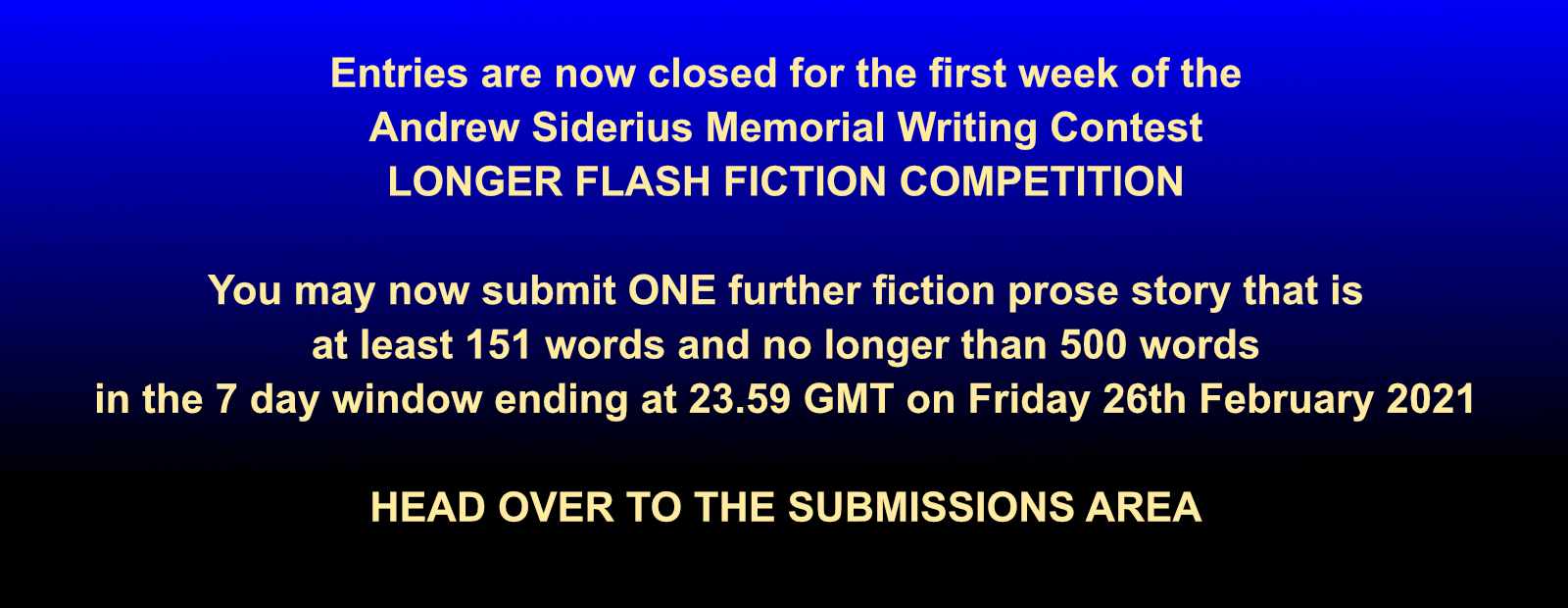
The Andrew Siderius Writing Contest (end of week 1)

20/2/2021

 
Picture

Milestone, by Michael Roberts

19/2/2021

 
TRAVEL
Over breakfast one morning my mother asks me for a favour.
“I’d like you to drive me in to see Aunt Beth this Thursday.”
“That’s kind of a big ask,” I tell her, “I’d have to call in sick to work. Again.”
She gives me a bit of that look like, “What do you mean, again?”
“You want me to come or not?”
“No need for that tone, young lady and, yes, I want you to come.”
“OK, depending…,” I tell her, “I’ll make sure taking the day off isn’t going to bite me in the ass first. It’s a weird day of the week to go visit her, though.”
“It’s not every day my sister turns fifty.”
“Well, technically,” I say,“ it only happens on one day.”
“Smart-ass,” my mother says.
She looks at me.
“So, yes?”
I shrug.
“I guess,” I say, “Seems like a long way for a short trip.”
“Mean a lot to me to have you come see her as well.”

Thursday morning, my mother wakes me up about eight.
“Ready?” she asks.
“Yeah,” I say through a yawn, “I’ll be downstairs in a couple minutes.”
When she leaves, I get up and go to my window and pull back the curtains.
The big snow we were supposed to get apparently went somewhere else, since there’s only a heavy dusting of it on the lawn.
That’s good news for the drive.
I get dressed, use the bathroom quickly, then head downstairs.
“Always nice when it snows on Anne’s birthday,” my mother says.
The traffic is fairly light by the time we reach the highway.
There’s a bit of a fender bender that slows us down, but we’re at the turnoff into the city by ten.
Even with the city traffic—which drives me crazy, by the way and I don’t how people manage to do it every day—we are down at where Anne is by eleven.
Her building is huge, something I still can’t get used to.
Where she is is in the lower floor, near the back.
Almost every time we come to visit, I always think it’d make more sense to just go in through the back.
They’ve just cleaned down here and the smell of Windex and carpet cleaner is almost over-powering.
I hope Mom won’t stay too long, but then realize that today of all days she’ll want a long visit.
Anne is in the corner, between Werner Liptnik and Yannu Taniapolopoulas.
I couldn’t imagine having neighbours named that.
They have a new floral display near the guest book and I quickly go over to look.
By the time I come back, Mom’s already talking to Aunt Anne.
I stay back a bit because this is her time with Aunt Anne.
Something about she was going to bring a cake but thought that would have been silly.
After a minute, she stands up and wipes her eyes, then replaces the flowers in the vase.
“Happy Birthday, big sis.”
​

The Stupid Gift, by Peggy Gerber

19/2/2021

 
TRAVEL
Alexis groaned as she read her mother’s text, “You didn’t thank your father for the birthday gift. He’s really hurt. Please give him a buzz, and when you speak to him don’t call him Frankie. He hates that.”

Alexis kicked the wall. Her mother seemed to keep forgetting that Frankie was her step-father, not her father and what kind of stupid gift was a family trip to Hershey Park anyway? She was eighteen years old and in college, for heaven’s sake and he was giving her a gift for a ten-year old. She wondered if he picked this gift because her half-sister was still little, and he was really just thinking about her.

Alexis rolled her eyes and picked up the phone to call her step-dad. When he answered she said, “Hi Frankie, thanks for the thoughtful birthday gift.”

Her step-dad bubbled, “I’m so glad you like it. I want you to know I put a lot of thought into what to get you for your special birthday Alexis. Do you remember that first trip we took to Hershey Park when you were eight years old? Mom and I had just gotten married and we wanted to do something special for you. Remember our tour of the chocolate factory when you got a mound of gooey chocolate stuck in your hair? We were all really laughing.”

Alexis sighed, “Sure Frankie, I remember. It was fun.”

“Yes, “He said, “ It was fun, but it was more than that for me. It was on that trip that I really got to know you and I began to feel like your dad for the first time. I gave you this gift because it is the tenth anniversary of when I fell in love with you, and I wanted to recreate, if just for a bit, that special vacation.” He added, “Sweetheart, I hope you know how much I love you and how proud I am to be your dad.”

Alexis began to cry. “I love you too Daddy. This is the best gift ever. I can’t wait to go.”

Fierce Hearts, by Angela Carlton

19/2/2021

 
FOOD
You were always with me. You had a taste for golden breads, cheesy pastas and roasted meats so I cooked for you. I opened windows so the breeze welcomed us and poured sparkling water with raspberries. Sometimes, I made us brownies with two scoops of ice cream. You liked two.

After dessert, we liked to take walks by the creek. The air tickled my face as I breathed in the life around me. Sometimes I sang to you, my eighteen-year-old voice thriving now, winning that college scholarship in the Arts. We waded in streams, fierce hearts pounding, water gushing over toes, the warmth of my body burning my cheeks like lava.

Every week, there were those doctor appointments. We were baffled by the reports, his findings. My fist clenched while his lips moved with the medical jargon I couldn't fully understand. There was less time, but I waited with the courage I'd stuffed somewhere. Outside, the pine trees swayed. People were chatting, laughing as we sat in the cold room, minds racing to the rhythm of my fears. On the way home, everything shifted. The sky was eerie blue, winds whistled against the sunroof. When the rain came, I watched the drops roll down the clear glass. In the silence, a branch snapped from a flimsy oak rolling around with a sudden fury that turned and roared inside me.

Just moments before the storm breaks, I do.

My bedroom was spacious, but cluttered. I shuffled this, tossed that as I desperately searched for some kind of order. Outside there were spring colors: soft teals, yellows and vibrant pinks. Still, I stayed behind the windows where things were familiar, safe. The sky’s not enough for me now.

It’s our final trip to the hospital. Food has become tasteless, but I pretend I have an appetite for you. I was thirsty, so damn thirsty, but nothing satisfied me so I poured more water and watched the ice float around in a plastic cup.

And then, poof, like that, you were gone.

I found I wasn’t as strong as I wanted to be. I slept for days and days until you came to me, floating aimlessly in a dream, leaving me breathless when I opened my eyes.
,
You, my tiny wonder, that dear boy, the one I let slip away.
​

The Unveiling by W.H. Forshee

19/2/2021

 
FOOD
The bonnet the child was wearing was a ruffled embroidered chiffon with lace trim and a bow imported from France. Grace pulled an upholstered chair out to sit and face the child. Her hand-stitched long burgundy dress with Irish crochet down the front was not as ornate as the child’s dress but then it wasn’t her unveiling.

The child stood swaying uncomfortably. Then with a hearty, “Good Morning”,
Dad appeared in his long frock coat. “Everyone comes to brunch and..” he stopped surprised and glanced down at the child dressed in a lace dress.
“ugh,” hoping his question might not ruin his morning, he asked, “Why is our son dressed as a girl?”

Grace remained seated but her bodice plunged a bit higher as she stiffened on the edge of her seat. Her festering wound begged her to scream but instead her words came low, sharp and stained with resentment. “Dear, you said we shan’t have the money for a new outfit so I figured Marcellina’s hand me down would do.”

It was dad’s turn to sigh now. He fought an urge to plunder his wife with the reality of their situation knowing full well she knew it. Grace was intelligent, artistic, a singer of great talent who gave up a future on the stage and in the spotlight to be his wife. He also knew she was fragile, easily broken. At times she was like a child caught in a wave of misery, petulant and pouty. His meager wages as a beginning physician didn’t begin to cover the luxuries she was used to, the extravagant clothes, the perfumes.

He bent down and whispered in her ear, “Oh dear, you are exasperating at times.” He was having trouble containing his disbelief at how far his wife would go for her own satisfaction. ‘I believe it will come out that Ernest is a boy sooner or later.” He winked at his son, proud even of the little chaps resolve to do as his mother asked.

“Umph “ Grace dismissed him loudly. Her chin plummeted upward as she twisted away, “Go see your patient’s Dr. Hemingway and leave us alone.”

To Only Exist in Memories and Faded Photos, by John M. Carlson

19/2/2021

 
SPORT
I almost wish I hadn’t come back here, Jeff thought, as he looked around the outdoor swimming pool.

He’d grown up a few blocks away. But he hadn’t been back to this pool in many years, and it had really deteriorated in that time. The pool house paint, which had been so bright and colorful, was now faded and dingy. The diving board, which had been so much fun when he was a boy thirty years before, was now gone. The pool deck had cracks. And he’d heard the pool itself was in terrible repair, leaking a huge amount of water every day. The only thing that still looked the same was the blue sky overhead. But even that probably wasn’t as good as it once had been, thanks to pollution from the fast growing city.

Friends had told him the pool was falling apart. But it was still a shock seeing the reality.

Jeff jumped feet first into the lap lane. How many thousands of times had he jumped feet first into this pool?

As Jeff swam, he remembered his summers at this pool when he was a kid. He practically lived here in summer. He had tons of memories and a photo album full of faded photos taken here.

His memories of this pool started with the first time his dad brought him here to play in the shallow end. A year later, he started swim lessons here—and wondered if he’d ever be good enough to jump off the diving board. There was his first jump off that diving board, when he had a mix of fear and excitement. There were the cannonball dive contests with friends. There was the path he wore in the field behind his house after countless trips to and from the pool. He spent several years on a summer swim team here. There were lots of team practices, followed by pizza with his friends. Some races he won, and some that he lost. His first crush was a lifeguard. His first job was teaching swim lessons here. As an adult, he swim laps here, until he moved an hour away to take a new job.

Time flew that afternoon. As it always had. Maybe this was the only thing that had never changed. And before he knew it, the session was over. This ended the last time he’d ever swim here. The last time anyone would swim here. This was the last session of the year. Next year, this pool would be replaced by a new pool. They’d start demolishing this old pool within a few days.

Jeff knew they needed a new pool. This pool was worn out. But...he felt sad. This pool had been such a big part of his life growing up. Soon this pool would only exist in memories and faded photos in photo albums.

History in the Making, by Sandra James

18/2/2021

 
FOOD
Rushing to get through at least some of the long list of tasks I’d set myself for the day, I noticed a missed call message on my phone from my eldest son who lives with his nine-year-old son in the small town near our rural home.

My grandson Jackie answered when I called back.

‘Grandma, when are you going to bring me my chocolate cake?’

Damn! I’d forgotten I’d promised on the weekend that I’d bring him cake today on my way to the post office.

‘I just wanted to know what time because we have to go out for a little while,’ he continued.

‘What time are you going out?’

‘Sometime between twelve and two.’

Perfect, that gave me time to make some chocolate cupcakes, let them cool before I iced them, then drop them off on my way to the post office.

‘That’s great,’ I told him. ‘I was coming just after two o’clock.’ I crossed my fingers as I spoke, glad he couldn’t see me.

‘Cool. See you then.’ Never one to stand on ceremony, he hung up.

I knew the recipe by heart but reached for my old recipe book out of habit. Yellowed pages, stained with food-splash memories from goodness knows how many baking sessions over its forty years of service and a multitude of magazine clippings inside the cover.

Carefully turning the fragile pages, I read the headings - Date Loaf, Banana Cake, Plum Pudding and Coconut Cookies. I’m instantly transported back to my Nan’s tiny kitchen, the old gas stove in the corner, my special drinking glass in the dish drainer and the wooden stool my Pop made for me to stand on. I can smell the delicious aroma of her pumpkin scones, the ones I wouldn’t believe were made with pumpkin because at seven I hated pumpkin. But they were yellow, my favourite colour, and I tried them and they were delicious. Dad, Mum and my brother laughed but Nan showed me how to make them, and as an adult I love pumpkin and still make scones.

I recall the miniature cake tray, rolling pin and spoons I got for my sixth birthday. Mum never had time to let me use them, told me I’d make too much mess, but on school holidays Nan patiently helped me make tiny cakes and sat down to a picnic with my dolls afterwards.

I vow to make all the recipes in the book, relive all the memories again but today I’ll start with the chocolate cake, the recipe painstakingly written in my late brother’s juvenile handwriting. I hear his voice. ‘You have to make lots of chocolate cakes, Sis!’

Jackie loves chocolate cake and he often helps me in the kitchen. Perhaps one day, when he’s my age, his heart will beat a little faster when he remembers cooking with Grandma, and keep the tradition alive with his grandchildren.
​

Awkward, by Mary Wallace

18/2/2021

 
FOOD
‘Damn’ he thought, he’d finally got up the courage to ask Louise out on a date; not an easy thing when you’re a tubby 60 year old with less hair than the day you were born. Still, his daughter assured him that some women considered bald men sexy.
But no one was going to think being hard of hearing was sexy and he’d forgotten his hearing aids. “Damn, damn, damn!” No time to go back for them, it would be the quickest date in history.“Sorry I’m half an hour late, I had to go back for my hearing aids;” sexy as hell! He would just have to wing it.
Dinner went well. The restaurant was quiet and the conversation flowed; Leo began to feel more comfortable. Louise didn’t seem to mind his lack of hair, or the stomach that strained against his shirt buttons. Leo’s hearing difficulties were forgotten in the refined atmosphere of the restaurant.
Getting up to leave, Louise’s next words were drowned slightly in the scraping of the chair legs.
“Shall we go to my car,” is what Leo heard, but obviously she had mentioned a bar, for very soon they were sitting together in a cacophony of noise, having a drink. This brought his lack of hearing aids to the forefront of his mind, but he consoled himself with the knowledge that the aids would be next to useless in such a rowdy place, so he made the best of the situation by leaning in close to Louise.
“Terribly loud here,” Louise tried to make conversation.
“Yes a big crowd,” he agreed.
“Too loud I think.”
“Ok I’ll get you a drink.”
Louise wondered if he was trying to ply her with alcohol. While Leo went to the bar, Louise made her way to the ladies room to repair her lipstick. She was wearing a vibrant shade of red which was the first thing Leo noticed on her return.
“Did you miss me?” Louise blushing under his gaze made an attempt at being flirtatious. Leo, not needing to be asked twice, leant over and bestowed a kiss on her luscious lips, both seeming a little surprised at how fast the relationship was progressing.
“It’s too noisy here, I can’t hear myself think,” said Louise trying to regain her composure.
“No thanks, not another drink, we should probably go.”
“Yes alright, take me home. It's been a lovely evening but too much alcohol goes straight to my head.”
Normally that sort of forward invitation on a first date would have put him off, but really, when you were 60 and getting fatter there was no time to waste. Leo took Louise home to bed.

"74 Flow," by Bob Ellis

17/2/2021

 
SPORT
When Coach called for “74 Flow,” Arthur Stoddard stood taller than his six-foot six. Every team has a trick play or two for infrequent use. Despite Fiero Hills’ opponents facing “74 Flow” at least once per game, it remained in the Flames’ playbook.

Art was the largest senior at the small rural high school; Coach often had trouble getting the required thirty boys out for football. Art played offensive tackle, 285 pounds of tough ranch-hand, Flames’ number 74. Colleges offered football scholarships; Art was leaning towards Idaho State.

Fiero Hill’s most popular student was Richard Rudner. Elected Class President and Junior Prom King, Rich was good looking with a devil-may-care manner, but stood only four-foot, three-inches and weighed just 85 pounds. Rich’s body couldn’t manufacture key hormones but, by taking HGH, he gained ten pounds and two inches over the last three years. When Rich went out for football, Coach ordered a special uniform and pads, paid for out of his own pocket.

It was too dangerous for Rich to play regularly; a falling player or aggressive tackle could put him in hospital for months. Coach let him play in practices and scrimmages where no-one tackled him. Scrimmagers held Rich up until Coach blew his whistle to end the play.

But when Coach dialed in his “74 Flow” play, Rich took the field in the tailback position, a miniature in the red and black Flames uniform. Everyone in the bleachers and along the sidelines began yelling Rich’s name. Even the opposing players, who knew exactly which play was coming, would shout encouragingly.

The quarterback, Phil Davis, ran a quick count and received the ball on the first “Hutt.” Dropping back, Phil handed the ball backwards to Rich, while the Flames’ linemen and half-back pulled out to the right, creating a wedge of heavy bodies. Art waited besides the quarterback and in front of Rich. After three “Mississippi’s,” Rich tucked the ball into the pouch in his jersey, ran forward and grabbed the reinforced collar of Art’s shoulder pads. Art took off down the field behind the blockers.

Linebackers and safeties bounced off Art as he trundled down the field with Rich hanging on behind. Art never went down; if he failed to score, he just allowed himself to be stood up by the tacklers until the Ref blew the play to a halt.

Usually, Art would lumber into the end zone, Rich still holding tight to his pads, the ball wedged between them.

“Touchdown, Flames,” the announcer yelled.

When Art got sick thirty years later, he warmly recalled his high school football games and “74 Flow.” Art never played college ball; economic conditions required working the family’s ranch.

When able to sleep, Art dreamt of crossing the goal-line with Rich hanging on his back, the ball poking between his shoulder blades. The good memories helped; those same shoulder blades had been reduced to small bony wings, following surgery to remove portions of his lungs to defeat the virulent cancer.

Quest for Gold, by Krystyna Fedosejevs

16/2/2021

 
SPORT
Why wouldn’t Freda consider an upcoming race? She was an outstanding nordic skier. Known for training commitment and outstanding performance.

Cora, a novice, rarely signed up for a race Freda entered.

“You are out there to do your best and have fun,” her mother rationalized. “That’s most important. If you don’t win, no big deal.”

Support from close ties had Cora leaving insecurity behind and signing up.

Race day breezed in with favourable weather. A sizeable audience had formed to cheer on one hundred or more participants.

“Get ready! Get set! Go!” yelled the race announcer.

Better athletes were soon out of sight. Cora maintained her steady, slower pace with the sole goal of completing the course.

Making her way through the forest, she was surprised at what awaited her at the end of one turn. Leaning against a pine stood the star performer, Freda. Cora stopped to learn what had happened.

One by one, contestants glided through the finish line. Among them, Freda, who secured a bronze medal. Cora hobbled into view at the very end, receiving an applause from the spectators.

In her acceptance speech, Freda acknowledged several individuals. Foremost, the one who offered a helping hand at a desperate moment during the race.

Cora smiled, feeling good to have lent one of her skis when Freda’s binding broke.

Mardi Gras in Texas, by Susan Fairfax Reid

16/2/2021

 
FOOD, TRAVEL
Susan couldn't go to New Orleans this year to celebrate Mardi Gras, so she celebrated at her Texas ranch.
Mardi Gras, a French term, translates to Fat Tuesday, a day when cooks historically used all of their butter, fat, and milk before lent, resulting in the rapid cooking of fried foods and pancakes.
Susan began her day brewing a New Orleans special, a cup of Cafe Au Lait, a Creole drink made of milk and a mixture of a premium blend coffee and chicory. The strong blend is unpalatable without milk at Cafe du Monde in N'awleens, if you've ever tried it. Since beignets, fried dough covered in powdered sugar, another Cafe du Monde offering, are scarce in Texas, Susan cooked pancakes. Other names for Mardi Gras are Shriving Tuesday, a day to confess and repent, and Pancake Tuesday, when many churches offered pancake meals in pre-pandemic days. After Susan cooked the pancakes to a golden color, she spread butter on each one and poured the amber maple syrup on them until she created a sweet moat around the pancakes. With a piece of pancake on the end of a fork, she mopped up the syrup and savored it like a woman scooping the last hot fudge out of a sundae glass to avoid missing a single warm taste of the thick chocolate.
At lunch time, she popped a Louis Armstrong CD in her boombox to honor him and the other musicians who gave N'awleens the name, Birthplace of Jazz. Some say jazz was born there with drumming and voodoo rituals on Congo Square. Others say it started when Buddy Bolden formed a band in 1895.
Then, Susan showered, dabbed on voodoo perfume, custom blended for her in N'awleens French Quarter, and dressed in party clothes--emerald green leggings, a purple sweater, and a gold necklace, official Mardi Gras colors. Purple represents justice. Green represents faith. Gold represents power. You'll find these colors in food, clothing, accessories, and beads.
In the past, Krewe members, or club members, tossed beads to spectators from floats they built and rode on during pre-Covid-19 Mardi Gras parades.
Donned in her elaborate eye mask, a tradition so that social classes couldn't be identified, and her face mask, Susan borrowed her husband's truck to get ingredients for gumbo, a staple in N'awleens restaurants, and ingredients for those fruity, potent drinks called Hurricanes, named after the storms that frequently hit N'awleens and, like Katrina, have had devastating effects on the city's residents. She also bought a King Cake, a huge pastry, covered in white icing, and green, purple, and gold sprinkles, and decorated with a strand of beads. Inside the cake is a plastic baby, representing Jesus. Traditionally, whoever gets the slice with the baby, has to buy the cake for next year's party.
All went well at the store, so Susan didn't have to insert pins into her male and female voodoo dolls she bought in N'awleens.
​

Italy, by Blake Arnott

14/2/2021

 
TRAVEL
Eager to check up on him, she tiptoes into his room with her beloved dog, Millie by her side. From a nearby sound system, a singer’s sweet and melodious voice fills the air and enchants Abigail with its beautiful sound. And as her soulful eyes drift to the dearly loved man asleep in bed, rays of morning light pour in through open curtains to warm her troubled heart.

Her brown eyes glisten with unshed tears when they sweep over a lacquered dresser against a wall. On top are photos of her son wrapped in a cocoon of his loving family. As they laugh and dance in front of the cameras during an earlier trip abroad, Abigail sighs as it rekindles old memories that shuffle through her brain like a deck of cards.

With no further delay, she walks to her son’s bedside and scrutinizes his handsome face. Though his eyes are closed, when awake, the corners crinkle when he smiles, and the pure radiance lights up the room for all the world to see.

“I love you.” “I am here,” she whispers in his ear and kisses his pale cheek.

Gently, she cradles his head in one hand and fluffs his pillow with the other. She then runs her hand over the soft bristles of his fair hair and lightly massages his scalp and neck.

She wonders if he is cold. She reaches for the blanket folded at the end of the bed and covers him with it.

Abigail opens the top drawer of a nightstand that stands by the bed and removes a collection of popular travel guides to Italy.

“Fasten your seatbelt, son. We are on our way,” she says as she curls up in a bedside recliner, the travel guides in her lap, her head against the backrest, and begins to read out loud. Later that morning, she fails to notice a turn of a head, a faint smile, or a tear that rolls down a cheek.

And there is Millie, still by her side.
​

First Class Fare, by Sue Clayton

14/2/2021

 
TRAVEL
“Ladies and gentlemen, May I have your attention?” The aircraft’s PA system crackled into life. Cabin noise diminished to a hum. Would it say something interesting? Light relief from the tedium of a fifteen hour flight.
Flight ZA53’s passengers, escaping to exotic golden sands and warm tropical waters far from the snow and ice of a winter-gripped England, were all ears.

“This is your Captain speaking. We are experiencing a slight technical problem. Please fasten your…”
The PA crackled then died. Cabin noise increased to a roar as the aircraft juddered violently and plummeted towards turbulent waves below.
Cassandra Fortescue-Jones drained her brimming champagne flute before the rapid descent slopped the bubbly over the side.
“Needs a refill,” Cassandra’s fat fingers waved her champagne flute knocking the attendant’s navy-blue hat with cheery red band into the aisle.
“Madam, we have an emergency situation.”
“I paid a first-class fare and demand first-class service.”
“I’ve more urgent things to worry about than your first-class service. Fasten your seat belt.” The Flight Attendant continued to stagger down the aisle, her hat twisted to one side.
“Brace for impact,” the aircraft ditched into the roiling sea.

“Madam, your shoes,” the First Officer bellowed as Cassandra shoved past him, preparing to shoot her lumpy body down the slowly inflating escape slide, spiky heels ready to rip into the nylon.
“No need to shout,” she screamed back, stilettos in hand as she hurtled down the slide and leapt into the rubber life-raft attached at the bottom.

“My cosmetics case,” a frantic cry rang out. Cassandra pouted Botoxed lips and batted dewy water-resistant mascaraed eyelashes at the First Officer. “Can we paddle back and look for it? It might be floating in the water. It’s Italian, in a lovely raspberry and gold shade. Cost a fortune.”
He ignored her as the aircraft’s fuselage became a tiny visage as the raft drifted further away.
“Repulsive oaf,” she glowered, as the head of the man next to her fell into her lap.

On the far side of the raft the Flight Attendant watched what appeared to be a caring woman comforting a young man.
“She crawled across to Cassandra. “Can you help with the injured?”
“Good luck with that,” the First Officer gave a tiny snigger.
“I need help,” she held up a broken nail. “And I’ve a throbbing headache.”
“Your nail’s not an injury and we’ve all got a headache.” The Flight Attendant removed the young man and sandwiched him between two more compassionate survivors.
“You’ll regret your insolence,” Cassandra leapt angrily to her feet. A gigantic wave deluged the raft then swept back out to sea—taking her with it.
“Throw me a lifebelt,” a dizzying scream rang out across the waves.
“We don’t carry lifebelts.” The First Officer’s voice drifted back.
Cassandra disappeared beneath the surface in a whirlpool of froth. Fifteen minutes later she floated back to the surface; food for the sharks—when they arrived to dine on the first-class fare.

Bottoms Up. by Andrew Carter

14/2/2021

 
TRAVEL
The Dazzlin’ C makes way to C-Shape Reef, northeast of Cooktown. Several dories follow her like a locomotive followed by several cars. It works the Great Barrier Reef Marine Park targeting coral trout.

Artie has over two years of ‘at sea’ time up. He’d travelled to Cooktown to gain his remaining sea time for his Master V skipper’s licence. Cooktown is popularly known as ‘The End of The Road’ or, ‘The Greatest Unfenced Asylum in Far North Queensland’. It’s an alcoholic’s paradise, and it’s Artie’s last trip before sitting his Master V skipper’s exam.

His skipper and mentor, Luka ‘Lucky’ Fischer, anchors off C-Shape Reef because it’s fished-out forcing his crew to poach the nearby Green Zone. The Green Zone is illegal to fish, but it’s loaded with product.

Artie cuts a wiry figure with tiller-in-hand as he heads to the Green Zone in his five-metre fibreglass dory. His sea-drenched shorts dry in torrid tropical heat turning his boardies into chafing emery cloth. He idles back, then drops his irritating shorts preferring jocks alone.

Entering the waters around the Green Zone incurs hefty fines. Stock declines force Lucky’s crew take pecuniary risks fishing highly protected areas and it’s enough of a gamble with nautical elements, let alone dodging spotter plane cameras.

Artie slows to neutral and hurls the reef pick. Coils of rope catch his freshly discarded shorts dragging them into the depths below. Banana fish leap with a WOOSH. He chuckles as a quote from J.D. Salinger pops in his mind – “If coral trout feed on banana fish, what are the banana fish feeding on?”

He casts his bait. Facing northward, he sees a bird-like object high above Lizard Island. He sets his handheld radio to VHF band. Immediately, it blasts. “Ay, ay, ay,” Lucky barks, in his uncrackable code for ‘spotter plane’.

“Yeah, yeah, yeah,” Artie articulates. He converts to plain speech.

Artie rips the outboard’s cowling off to feign he is working on a broken-down outboard. Frantically, he winds his line as a fresh southerly gust blows his cap off.

Immediately after, an albatross drops a large bomb on his head. In a fit of unrestrained lunacy, Artie strips his jocks off and shakes his bare buttocks at the approaching spotter plane, the low-flying southbound seabird, and God.

The Cessna dips its wings as the fisheries officer snaps photos. A gust blows Artie’s undies into the windswept ocean. His eyes darken, then he slices the anchor rope to hasten rescue of his far-flung briefs. Reaching out with a gaff hook he nearly retrieves his slowly sinking underwear.

Head bowed; he returns to the main boat naked where he’s greeted by Groove Armada’s song blasting from the deck speakers:

I see you baby
Shakin’ that ass
Shakin that ass


Lucky yells, “What a crack-up!”

Artie climbs aboard from his dory. A crewmate hands him a beer. He wipes his sunnies and replies with resigned humour, “Bottoms up,”

He wasn’t quite over the moon.
<<Previous
Forward>>

    Longer
    Stories

    For the foreseeable future, the Longer Flash section is closed to submissions.

    Archives

    July 2025
    June 2025
    May 2025
    April 2025
    March 2025
    February 2025
    January 2025
    December 2024
    November 2024
    October 2024
    September 2024
    August 2024
    July 2024
    June 2024
    May 2024
    April 2024
    March 2024
    February 2024
    January 2024
    December 2023
    November 2023
    October 2023
    September 2023
    August 2023
    July 2023
    June 2023
    May 2023
    April 2023
    March 2023
    February 2023
    January 2023
    December 2022
    November 2022
    October 2022
    September 2022
    August 2022
    July 2022
    June 2022
    May 2022
    April 2022
    March 2022
    February 2022
    January 2022
    December 2021
    November 2021
    October 2021
    September 2021
    August 2021
    July 2021
    June 2021
    May 2021
    April 2021
    March 2021
    February 2021
    January 2021
    December 2020
    November 2020
    October 2020
    September 2020
    August 2020
    July 2020
    June 2020
    May 2020
    April 2020
    March 2020
    February 2020
    January 2020
    December 2019
    November 2019
    October 2019
    September 2019
    August 2019
    July 2019
    June 2019
    May 2019
    April 2019
    March 2019
    February 2019
    January 2019
    December 2018
    November 2018
    October 2018
    September 2018
    August 2018
    July 2018
    June 2018
    May 2018
    April 2018
    March 2018
    February 2018
    January 2018
    December 2017
    November 2017
    October 2017
    September 2017
    August 2017
    July 2017
    June 2017
    May 2017
    April 2017
    March 2017
    February 2017
    January 2017
    December 2016
    November 2016
    October 2016
    September 2016
    August 2016
    July 2016
    June 2016
    May 2016
    April 2016
    March 2016
    February 2016
    January 2016
    December 2015
    November 2015
    October 2015
    September 2015
    August 2015
    July 2015
    June 2015
    May 2015
    April 2015
    March 2015
    February 2015
    January 2015
    December 2014
    November 2014
    October 2014

Picture
Website by Platform 36